Two dreamers and a gyroscope
A famous car stylist and a gyroscope engineer set out to build the car of the future.
Alex Tremulis, the stylist
Tremulis was chief stylist of the Tucker 48, from 1947. Octane, 2026
He became chief of advanced styling at Ford in 1952, and left in 1963 to start his own design consultancy. Octane, 2026
Tremulis’s interest in gyroscopes began in the Second World War, when he studied the gyroscopic guidance of a V2 rocket. Octane, 2026
A Ford colleague, Bob Thomas, remembered Tremulis tying a toy gyroscope from an army-surplus shop to a bar with two wheels in a line, then sending it across the studio, where it went straight as an arrow into the far wall. Octane, 2026
Those experiments led to the Ford Gyron, a two-wheeled two-seater concept car shown at the 1961 Detroit Auto Show. Octane, 2026
Ford’s management was unconvinced, and balked at the projected $135,000 cost of developing a working gyroscope. Octane, 2026
At Ford, Tremulis also encouraged a young designer, Jim Powers, to develop the idea that became the Ford Nucleon, an atomic-powered concept car. Hemmings (Kurt Ernst)
The atomic concept has a site of its own: the Ford Nucleon.
Thomas Summers, the gyroscope man
Summers had set up the Summers Gyroscope Company in 1946, and in 1961 he formed the Summers Gyrocar Company in Northridge, California, to develop gyro-stabilised vehicles. Octane, 2026
Before the Gyro-X, the Summers Gyrocar Company had built five small two-wheeled “mules” for the US Department of Agriculture, to carry loads slowly up mountain tracks. Octane, 2026
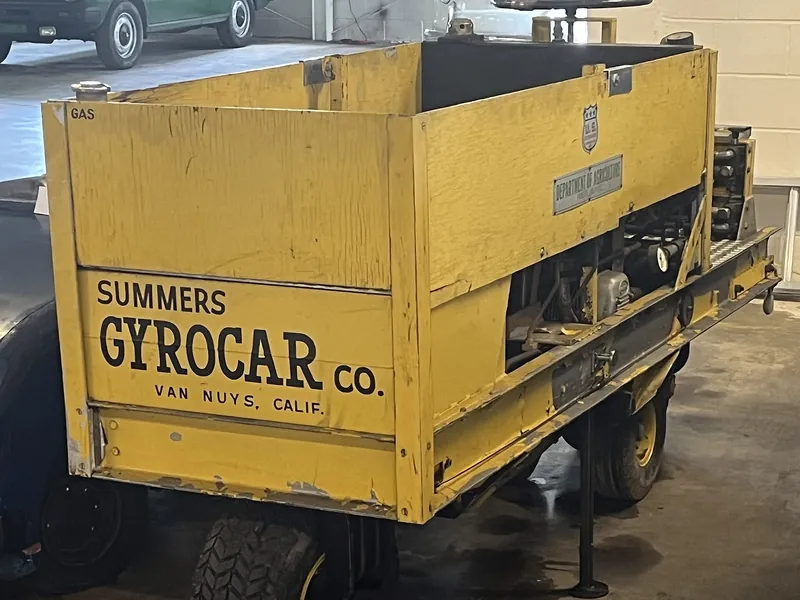
“Four wheels are ridiculous, three wheels are foolish, but two wheels are proper,” Summers explained in 1975. Octane, 2026
Summers applied for a US patent for a “gyro stabilized vehicle” on 31 March 1966, and it was granted on 12 November 1968. US patent 3,410,357
The Gyro-X
Summers and Tremulis met in 1966. Octane, 2026 Summers raised $750,000 for the venture. WIRED, 2017
Its tubular spaceframe and all-aluminium body were hand-built by the Los Angeles coachbuilder Troutman-Barnes. Octane, 2026 It had a pop-up headlight and four tail lights from a Chevrolet Corvair. Octane, 2026
The pitch: two wheels instead of four meant a smaller, lighter car that could use a smaller engine, a slim body that cut wind resistance, and half as many tyres to drag along the road. Lane Motor Museum Its makers also argued that if everyone drove a gyro car, traffic lanes could be cut by half. Agency Impianti
Under the bonnet was British engineering. The Lane Motor Museum lists the Gyro-X’s engine as coming from a Mini Cooper S. Lane Motor Museum Its story starts with the Mini, on our sister site.
The show car
It was first shown in “The Wonderful World of Wheels”, an exhibit at the 1967 New York International Auto Show. Lane Motor Museum Octane gives the date of the New York unveiling as 1 April 1967. Octane, 2026
It was promoted as reaching 125 mph on an 80 hp Mini Cooper S engine, and as swooping through 40-degree banked turns without tipping. Lane Motor Museum That September it was on the cover of Science and Mechanics magazine, billed as “impossible to skid or flip”. Lane Motor Museum
When the car was shown to the motoring press, its gyroscopic control system had been taken out. Octane, 2026
Timeline
- 1946 Summers had set up the Summers Gyroscope Company in 1946, and in 1961 he formed the Summers Gyrocar Company in Northridge, California, to develop gyro-stabilised vehicles. Octane, 2026
- 1961 Those experiments led to the Ford Gyron, a two-wheeled two-seater concept car shown at the 1961 Detroit Auto Show. Octane, 2026
- 1966 Summers and Tremulis met in 1966. Octane, 2026 Summers applied for a US patent for a “gyro stabilized vehicle” on 31 March 1966, and it was granted on 12 November 1968. US patent 3,410,357
- 1967 It was first shown in “The Wonderful World of Wheels”, an exhibit at the 1967 New York International Auto Show. Lane Motor Museum
- around 1970 Gyro Transport Systems, Inc. went under around 1970, and the Gyro-X never went into production. Lane Motor Museum
- 1975 By January 1975 Summers had added a third wheel so that it could be licensed in California, where vehicles over 1,500 lb could not count as motorcycles. Lane Motor Museum
- 1994 In July 1994 it changed hands to settle an unpaid loan. By then it was a Volkswagen-powered three-wheeler, and the gyroscope was long gone. Lane Motor Museum
- 2011 The Houston collector Mark Brinker sold it to the Lane Motor Museum in Nashville in December 2011. Lane Motor Museum
- 2017 The restored car made its debut at the Pebble Beach Concours d’Elegance on 20 August 2017, 50 years after it was created. Agency Impianti
Next: how it worked →