What happened to the Gyro-X
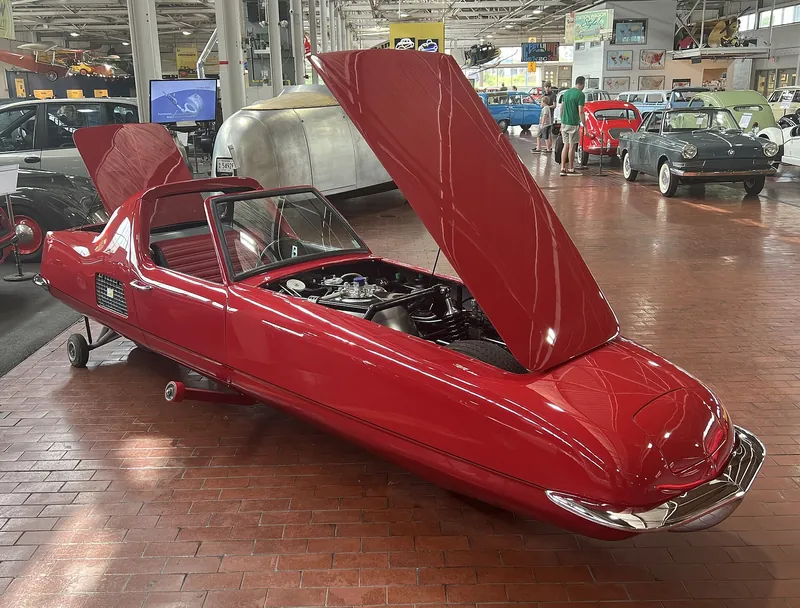
The company folded, the car was parked outside, a wheel was added and the gyroscope vanished. Then a museum bought it.
The claims and the reality
Octane’s verdict, in 2026: in reality, the prototype could do none of these things. Octane, 2026
Witnesses remembered that at high speeds, over 70 mph, it was unstable. Lane Motor Museum “We had stabilisation problems in high-speed cornering that were never resolved,” Robert Poteet, who worked for the Summers Gyrocar Company, recalled in 2018. Octane, 2026
Period film, often quietly speeded up, never showed it moving much faster than walking pace. Octane, 2026
Lost
Gyro Transport Systems, Inc. went under around 1970, and the Gyro-X never went into production. Lane Motor Museum
In July 1970 Tremulis wrote that he was greatly disturbed to find the Gyro-X parked outside, uncovered and exposed to the weather and vandals. Lane Motor Museum
By January 1975 Summers had added a third wheel so that it could be licensed in California, where vehicles over 1,500 lb could not count as motorcycles. Lane Motor Museum
In 1978 it was on the cover of Summers’s booklet Gyrovehicles: a New Concept in Land Transportation, renamed the Gyroglide. Lane Motor Museum
In 1981 Tremulis wrote to Summers: “May 1981 be the year of the GYRO.” Lane Motor Museum
In July 1994 it changed hands to settle an unpaid loan. By then it was a Volkswagen-powered three-wheeler, and the gyroscope was long gone. Lane Motor Museum
Found
The Houston collector Mark Brinker sold it to the Lane Motor Museum in Nashville in December 2011. Lane Motor Museum
Alex Tremulis’s nephew, Steve Tremulis, supplied a large archive of photographs, which guided the restoration. Octane, 2026 The aim, Jeff Lane told Octane, was to return the car as closely as possible to what it was in 1967. Octane, 2026
The restorer, Michael Hüby, ended up making almost everything needed to make it drive, from the chain drive and gear-change mechanism to the rear swing-arm, front suspension and brakes. Octane, 2026
The new gyroscope was built by Agency Impianti of Pisa, Italy, which makes gyroscopic stabilisers for large yachts. Octane, 2026 The new flywheel is a little smaller than the original: 104 kg and 434 mm across. Octane, 2026
Hagerty notes the original gyroscope was 22 inches across and the new one just 17 inches, with the same stabilising power. Hagerty, 2019
At 3,000 rpm, Jeff Lane says, it holds as much energy as a 900 kg car at 30 mph, and it keeps spinning for two hours after it is switched off. Octane, 2026
The museum spent about $500,000 on the restoration, more than half of it on the gyroscope. WIRED, 2017 The restoration took six years. Octane, 2026
Back in public
The restored car made its debut at the Pebble Beach Concours d’Elegance on 20 August 2017, 50 years after it was created. Agency Impianti
At Pebble Beach it won its class, American Dream Cars of the 1960s. WIRED, 2017 It also won the Dean Batchelor Trophy, for the most significant car related to hot rod heritage. Octane, 2026
“The gyro rocks a bit, like you’re sitting in a boat,” Jeff Lane said after his first drive. WIRED, 2017 In 2017 Lane admitted it did not yet work well above 25 mph: the controls were not precise enough to keep it stable at higher speeds. WIRED, 2017
By 2026 the team was running version 129 of the control software. Octane, 2026 Hüby has driven it in Nashville traffic and reached 55 mph on a private track. Octane, 2026
Failure or ahead of its time?
Hüby argues it should not be seen as a failure: regenerative braking, stability control and aerodynamics, all part of the Gyro-X idea, have since found their way into modern cars. Octane, 2026
Next: myths vs facts →